







CalculatorsConvertersAbout UsContact

Factor Calculator

Find the factors, factor pairs and prime factorization of a number, see if it is prime, and check if one number is a factor of another.

  • Free to use
  • No sign-up
  • Numbers stay in your browser

Last updated:

Find the factors

Enter a whole number from 1 up to 1,000,000,000,000 (1 trillion).

The box starts with an example: change the number, then press Calculate. On the other tabs you can enter several numbers (GCF and LCM) or two numbers (is it a factor?).

Your answer

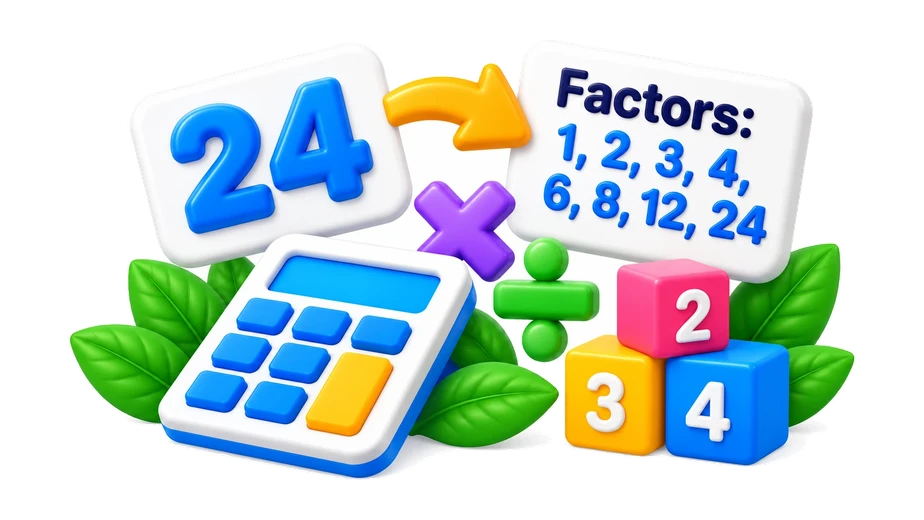
The factors of 24 are
1, 2, 3, 4, 6, 8, 12, 24
8 factors in all

24 has 8 factors and is a composite number. Its prime factorization is 2³ × 3. A factor is a whole number that divides 24 with no remainder.

  • Total factors8(3 + 1) × (1 + 1)
  • Factor pairs41 × 24, 2 × 12, 3 × 8, 4 × 6
  • Prime factorization2³ × 32 × 2 × 2 × 3
  • Prime factors2 and 3the different primes
  • Sum of factors601 + 2 + 3 + 4 + 6 + 8 + 12 + 24
  • TypeCompositeeven, not a perfect square

Factor pairs of 24: two factors that multiply to give 24.

1 × 242 × 123 × 84 × 6

Calculation steps

  1. 1Divide 24 by 1, 2, 3 … up to its square root (about 4.9)24 ÷ 1 = 24 · 24 ÷ 2 = 12 · 24 ÷ 3 = 8 · 24 ÷ 4 = 6. Every one of them divides with no remainder.
  2. 2Each division gives a pair of factors1 × 24, 2 × 12, 3 × 8, 4 × 6.
  3. 3Put the factors in order1, 2, 3, 4, 6, 8, 12, 24. That is 8 factors.
  4. 4Find the prime factorization24 ÷ 2 = 12, 12 ÷ 2 = 6, 6 ÷ 2 = 3, and 3 is prime. So 24 = 2 × 2 × 2 × 3 = 2³ × 3.
  5. 5Count the factors from the primesAdd 1 to each power and multiply: (3 + 1) × (1 + 1) = 8. Adding up all the factors gives 60.

Prime factor tree

Pink circles are prime numbers. Multiply them to get back to 24: 2 × 2 × 2 × 3 = 24.

242122623

Formula used

Factors and prime factorization
A factor of n divides n with no remainder, and every factor has a partner: a × b = n
Number of factors = (power of each prime + 1), multiplied together
Prime number: it has exactly two factors, 1 and itself

Factors of common numbers

NumberFactorsCountType
1, 2, 3, 4, 6, 126Composite
1, 2, 4, 8, 165Composite
1, 2, 4, 5, 10, 206Composite
1, 3, 7, 214Composite
1, 3, 5, 154Composite
1, 3, 9, 274Composite
1, 5, 7, 354Composite
1, 2, 5, 104Composite
1, 2, 7, 144Composite
1, 2, 4, 84Composite
1, 5, 253Composite
1, 2, 4, 5, 8, 10, 16, 20, 40, 8010Composite
1, 7, 493Composite
1, 2, 5, 10, 25, 506Composite

Click a number to put it into the calculator.

Factors of 1 to 50

NumberFactors
1
1, 2
1, 3
1, 2, 4
1, 5
1, 2, 3, 6
1, 7
1, 2, 4, 8
1, 3, 9
1, 2, 5, 10
1, 11
1, 2, 3, 4, 6, 12
1, 13
1, 2, 7, 14
1, 3, 5, 15
1, 2, 4, 8, 16
1, 17
1, 2, 3, 6, 9, 18
1, 19
1, 2, 4, 5, 10, 20
1, 3, 7, 21
1, 2, 11, 22
1, 23
1, 2, 3, 4, 6, 8, 12, 24
1, 5, 25
NumberFactors
1, 2, 13, 26
1, 3, 9, 27
1, 2, 4, 7, 14, 28
1, 29
1, 2, 3, 5, 6, 10, 15, 30
1, 31
1, 2, 4, 8, 16, 32
1, 3, 11, 33
1, 2, 17, 34
1, 5, 7, 35
1, 2, 3, 4, 6, 9, 12, 18, 36
1, 37
1, 2, 19, 38
1, 3, 13, 39
1, 2, 4, 5, 8, 10, 20, 40
1, 41
1, 2, 3, 6, 7, 14, 21, 42
1, 43
1, 2, 4, 11, 22, 44
1, 3, 5, 9, 15, 45
1, 2, 23, 46
1, 47
1, 2, 3, 4, 6, 8, 12, 16, 24, 48
1, 7, 49
1, 2, 5, 10, 25, 50

Divisibility rules

Divisible byHow to tellIs 24?
2The last digit is 0, 2, 4, 6 or 8Yes
3The digits add up to a number divisible by 3Yes
4The last two digits are divisible by 4Yes
5The last digit is 0 or 5No
6It is divisible by both 2 and 3Yes
8The last three digits are divisible by 8Yes
9The digits add up to a number divisible by 9No
10The last digit is 0No
11The digits, added and subtracted in turn, give 0 or a multiple of 11No

The last column checks the number you entered.

Factor or multiple?

A factor divides a number with no remainder. A multiple is what you get by multiplying a number by 1, 2, 3 … So 6 is a factor of 24, and 24 is a multiple of 6.

QuestionAnswer
Is 6 a factor of 24?Yes: 24 ÷ 6 = 4
Is 24 a multiple of 6?Yes: 6 × 4 = 24
Is 5 a factor of 24?No: 24 ÷ 5 = 4 remainder 4
Multiples of 66, 12, 18, 24, 30, 36 …

Prime numbers up to 100

Words to know

  • A factor is a whole number that divides another with no remainder. 4 is a factor of 24.
  • A prime number has exactly two factors: 1 and itself (2, 3, 5, 7, 11…).
  • A composite number has more than two factors, like 24. The number 1 is neither prime nor composite.
  • GCF is the greatest common factor: the biggest factor numbers share. LCM is the least common multiple: the smallest number they all divide into.
  • A perfect square has a whole-number square root, like 16 or 49. It has an odd number of factors.

What is included

  • All the factors and the factor pairs of a number
  • Prime factorization, with a factor tree
  • GCF and LCM of up to 10 numbers
  • Check if one number is a factor or multiple of another
  • Tables: factors of 1 to 100, divisibility rules, primes
  • Copy link and Print

Important to know

Enter whole numbers only. Factors are shown as positive numbers (every factor also has a negative partner). This calculator is for numbers, not for algebra such as x² + 5x + 4. Your numbers stay in your browser.

Use this free factor calculator to find all the factors of a whole number, its factor pairs and its prime factorization, drawn as a factor tree. You also see the number of factors, their sum, and whether the number is prime or composite, with the steps shown. Two more tabs give a quick GCF and LCM of up to 10 numbers, and check whether one number is a factor or multiple of another. For the full working of the GCF and the LCM, use the GCF Calculator and the LCM Calculator. Tables of factors of common numbers and of 1 to 100, divisibility rules and the prime numbers up to 100 are underneath. It is free and instant, and your numbers stay in your browser.

What are factors?

The factors of a number are the whole numbers that divide into it exactly, with nothing left over. To find them, try dividing by 1, 2, 3 and so on. Each time it divides evenly you have found a pair. You only need to try numbers up to the square root of the number, because the rest come from the pairs.

Example: the factors of 24
1, 2, 3, 4, 6, 8, 12, 24
They come in pairs: 1 × 24, 2 × 12, 3 × 8 and 4 × 6. The square root of 24 is about 4.9, so trying 1, 2, 3 and 4 is enough. The calculator also shows the number of factors (8) and their sum (60).

Another example: the factors of 36 are 1, 2, 3, 4, 6, 9, 12, 18 and 36. They come in the pairs 1 × 36, 2 × 18, 3 × 12, 4 × 9 and 6 × 6. Perfect squares such as 36 have an odd number of factors (9), because the square root pairs with itself.

Prime numbers and prime factorization

A prime number has exactly two factors: 1 and itself. 97 is prime, but 33 is not, because its factors are 1, 3, 11 and 33. The number 1 is not prime. Every other whole number can be written as a product of primes, called its prime factorization. For example, 24 = 2³ × 3, which means 2 × 2 × 2 × 3, and 360 = 2³ × 3² × 5. A factor tree shows the same thing: split the number into two factors, then split each one again, until only primes are left.

How many factors does a number have?

Write the number as a product of primes, add 1 to each power, and multiply. For 24 = 2³ × 3 that is (3 + 1) × (1 + 1) = 8 factors. For 360 = 2³ × 3² × 5 it is (3 + 1) × (2 + 1) × (1 + 1) = 24 factors.

Greatest common factor (GCF)

The GCF (also called the greatest common divisor, GCD, or highest common factor, HCF) of two or more numbers is the biggest number that divides all of them. The GCF of 12 and 18 is 6, and so is the GCF of 12, 18 and 24. One way to find it is to write each number as a product of primes and multiply the primes they all share, using the lowest power. Another is the Euclidean algorithm: divide the bigger number by the smaller, then the smaller by the remainder, and repeat until the remainder is 0. You use the GCF to simplify fractions: divide the top and bottom of 12/18 by 6 to get 2/3. To do the simplifying for you, use the Fraction Calculator. For the working shown three ways, use the GCF Calculator.

Least common multiple (LCM)

The LCM is the smallest number that all the numbers divide into. The LCM of 12 and 18 is 36, and the LCM of 12, 18 and 24 is 72. It is the number you use as a common denominator when adding fractions. For two numbers, LCM = (first × second) ÷ GCF: 12 × 18 ÷ 6 = 36. The LCM Calculator shows four ways to find it and lists the common multiples.

Factors and multiples

A factor divides a number with no remainder, and a multiple is what you get by multiplying a number by 1, 2, 3 and so on. 6 is a factor of 24, and 24 is a multiple of 6. To check whether one number is a factor of another, divide: 24 ÷ 6 = 4 with no remainder, so yes. 24 ÷ 5 = 4 remainder 4, so 5 is not a factor of 24. The “Is it a factor?” tab does this for any two numbers.

Quick divisibility tests

These shortcuts tell you if a number has a certain factor without dividing. A number is divisible by 2 if it ends in 0, 2, 4, 6 or 8; by 3 if its digits add up to a multiple of 3 (24: 2 + 4 = 6); by 5 if it ends in 0 or 5; by 9 if its digits add up to a multiple of 9; and by 10 if it ends in 0. Divisible by both 2 and 3 means divisible by 6. The table on this page checks your number against all of them.

What you can enter

For factors, enter any whole number from 1 up to 1,000,000,000,000. For the GCF and LCM, enter between 2 and 10 whole numbers, separated by commas or spaces. Factors are shown as positive numbers, as usual. Every factor also has a negative partner, such as −2 and −3 for 6.


View All Calculators

Frequently Asked Questions

What are the factors of 24?

The factors of 24 are 1, 2, 3, 4, 6, 8, 12 and 24. They make the pairs 1 × 24, 2 × 12, 3 × 8 and 4 × 6, and 24 = 2³ × 3.

How do I find the factors of a number?

Divide the number by 1, 2, 3 and so on, up to its square root. Each number that divides with no remainder is a factor, and the result of the division is its partner. For 24, 24 ÷ 4 = 6, so 4 and 6 are both factors.

What is a factor pair?

A factor pair is two factors that multiply to give the number. The factor pairs of 24 are 1 × 24, 2 × 12, 3 × 8 and 4 × 6.

What is prime factorization?

Prime factorization writes a number as a product of prime numbers. 24 = 2 × 2 × 2 × 3, which is written 2³ × 3, and 360 = 2³ × 3² × 5.

How do I find the prime factorization of a number?

Keep dividing by the smallest prime that goes in, until you reach 1. For 24: 24 ÷ 2 = 12, 12 ÷ 2 = 6, 6 ÷ 2 = 3, and 3 is prime. So 24 = 2 × 2 × 2 × 3. You can also draw a factor tree.

How do I know if a number is prime?

A prime number has exactly two factors: 1 and itself. If any other number divides it, it is composite. 97 is prime, but 33 is not, because 3 × 11 = 33. The number 1 is neither prime nor composite.

What is the difference between a factor and a multiple?

A factor divides a number with no remainder, and a multiple is the number multiplied by 1, 2, 3 and so on. 6 is a factor of 24, and 24 is a multiple of 6.

How do I find the GCF of two numbers?

Find the biggest number that divides both. One way is to list the factors of each and pick the largest one they share. The GCF of 12 and 18 is 6. You can also use prime factorization or the Euclidean algorithm. The GCF Calculator shows all three ways.

How do I find the LCM of two numbers?

The LCM is the smallest number both divide into. For two numbers, LCM = (first × second) ÷ GCF. The LCM of 12 and 18 is 12 × 18 ÷ 6 = 36. The LCM Calculator shows four ways to find it.

What are the factors of 12?

The factors of 12 are 1, 2, 3, 4, 6 and 12. The factor pairs are 1 × 12, 2 × 6 and 3 × 4.

How many factors does a number have?

Write the prime factorization, add 1 to each power and multiply. 24 = 2³ × 3 has (3 + 1) × (1 + 1) = 8 factors. 360 = 2³ × 3² × 5 has 4 × 3 × 2 = 24 factors.

Why do perfect squares have an odd number of factors?

Factors come in pairs, but for a perfect square the square root pairs with itself. 36 has the pairs 1 × 36, 2 × 18, 3 × 12, 4 × 9 and 6 × 6, which gives 9 factors in all.

Can a factor be negative?

Every factor also has a negative partner, because −2 × −3 = 6. The usual answer lists only the positive factors, and so does this calculator.

What is the largest number I can use?

For factors, up to 1,000,000,000,000 (1 trillion). For the GCF and LCM and for the check whether a number is a factor, up to 1,000,000,000,000,000.

Are my numbers saved or shared?

No. The calculation happens in your browser, and the numbers you type are not stored or sent to any server.