


CalculatorsConvertersAbout UsContact

Fraction to Decimal Calculator

Turn a fraction or mixed number into a decimal and a percent, with long division steps. Or turn a decimal into a fraction.

  • Free to use
  • No sign-up
  • Numbers stay in your browser

Last updated:

Convert a fraction

Whole
Top / Bottom

For a mixed number such as 3 3/8, fill the Whole box too. For a negative number, put a minus sign in front. The boxes start with an example: change them, then press Calculate.

Your answer

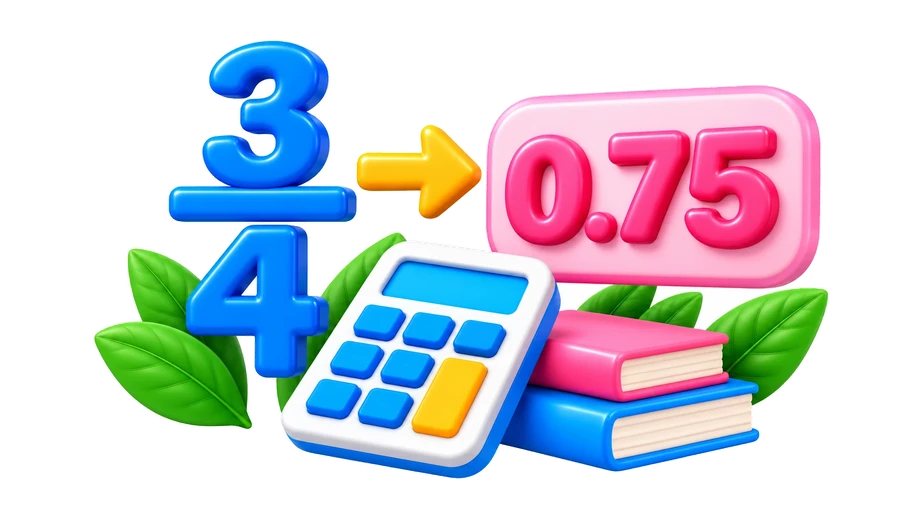
34 as a decimal is
0.75
The decimal stops after 2 digits

34 = 0.75. Divide the top number by the bottom number.

  • Percent75%decimal × 100
  • Decimal typeStopsends after 2 digits

A picture of the answer: 34 is 3 of 4 equal parts of the whole.

Calculation steps

  1. 1Reduce the fraction (optional)The greatest common factor (GCF) of 3 and 4 is 1, so 34 is already in lowest terms.
  2. 2A fraction bar means divide34 = 3 ÷ 4
  3. 3Do the long divisionAdd a decimal point and zeros, and divide until the remainder is 0 or comes back.
    DivideDigitRemainder
    3 ÷ 40 (then the point)3
    30 ÷ 472
    20 ÷ 450 (done)
  4. 4Write the answerThe remainder reached 0, so the decimal stops: 34 = 0.75.

Formula used

Fraction to decimal
Decimal = top number ÷ bottom number
Mixed number: Decimal = whole number + (top ÷ bottom)
Percent = decimal × 100
34 = 3 ÷ 4 = 0.75

If the remainder comes back during the long division, the decimal repeats forever. 1/3 = 0.(3) means 0.3333 and so on.

Common fractions as decimals

FractionDecimal
0.875
0.375
0.125
0.625
0.0625
0.2
0.(2)
0.(4)
0.4375
FractionDecimal
1.(3)
2.(6)
0.(3)
3.375
1.125
5.625
8.625
4.75
14.6

Click a row to put it into the calculator. A number in brackets repeats forever: 0.(3) is 0.3333…

Fractions of an inch

FractionDecimal inchmm
1160.06251.5875
180.1253.175
3160.18754.7625
140.256.35
5160.31257.9375
380.3759.525
7160.437511.1125
120.512.7
9160.562514.2875
580.62515.875
11160.687517.4625
340.7519.05
13160.812520.6375
780.87522.225
15160.937523.8125
1125.4

1 inch is exactly 25.4 mm. Handy for drill bits, wrenches and tape measures.

Fraction to decimal chart

FractionDecimal
120.5
130.(3)
230.(6)
140.25
340.75
150.2
250.4
350.6
450.8
160.1(6)
560.8(3)
170.(142857)
270.(285714)
370.(428571)
180.125
FractionDecimal
380.375
580.625
780.875
190.(1)
290.(2)
490.(4)
1100.1
3100.3
1110.(09)
1120.08(3)
5120.41(6)
7120.58(3)
1160.0625
3160.1875
5160.3125

Does the decimal stop or repeat?

Reduce the fraction first. If the bottom number only has 2s and 5s as prime factors, the decimal stops. Any other prime (3, 7, 11…) makes it repeat.

FractionDecimalType
180.125Stops
140.25Stops
130.(3)Repeats
160.1(6)Repeats
170.(142857)Repeats
190.(1)Repeats
1110.(09)Repeats
1120.08(3)Repeats

Words to know

  • Numerator is the top number and denominator is the bottom number of a fraction.
  • A terminating decimal ends, like 0.75.
  • A repeating decimal never ends, like 0.(3), which means 0.3333…
  • A mixed number is a whole number plus a fraction, like 3 38 = 3.375.
  • An improper fraction has a top bigger than the bottom, like 43 = 1.(3).

What is included

  • Fraction to decimal and decimal to fraction
  • Mixed numbers, improper fractions and negative numbers
  • The decimal, the percent and lowest terms
  • Whether the decimal stops or repeats, with the reason
  • Long division steps and the formula
  • Inch to mm table, chart, Copy link and Print

Important to know

The bottom number of a fraction can't be 0. A repeating decimal is shown with brackets, and the rounded value follows the number of places you choose. Your numbers stay in your browser.

Use this free fraction to decimal calculator to turn a fraction or a mixed number, such as 3/8 or 3 3/8, into a decimal and a percent. You see whether the decimal stops or repeats (like 1/3 = 0.(3)), and the long division is shown step by step. You can also round the answer to the number of decimal places you need. The second tab turns a decimal, such as 1.5, into a fraction in lowest terms. Tables of common fractions, fractions of an inch in decimals and mm, and a fraction to decimal chart are underneath. It is free and instant, and your numbers stay in your browser.

How to change a fraction into a decimal

A fraction is a division. The line between the top and the bottom number means “divided by”. To change a fraction to a decimal, divide the top number (the numerator) by the bottom number (the denominator). You can do it by long division or with this calculator.

Fraction to decimal: decimal = top ÷ bottom
Mixed number: decimal = whole number + (top ÷ bottom)
Percent: percent = decimal × 100

3/8 as a decimal: 3 ÷ 8 = 0.375. As a percent, that is 37.5%.

7/8 as a decimal: 7 ÷ 8 = 0.875, and 1/8 is 0.125.

Long division, step by step

To work out 3 ÷ 4 by hand, write 3 as 3.00. 4 goes into 3 zero times, so write 0 and a decimal point. Then 4 goes into 30 seven times (28) with 2 left over, and 4 goes into 20 five times with nothing left over. The digits are 7 and 5, so 3/4 = 0.75. The calculator shows every one of these steps in a table.

Mixed numbers and improper fractions

For a mixed number, keep the whole number and change only the fraction. 3 3/8 is 3 + 0.375 = 3.375, and 1 1/8 is 1.125. You can also turn the mixed number into one fraction first: 3 3/8 = 27/8, and 27 ÷ 8 = 3.375. An improper fraction, where the top is bigger than the bottom, works the same way. 4/3 = 1.(3) and 8/3 = 2.(6).

Terminating and repeating decimals

Some fractions give a decimal that stops, such as 1/8 = 0.125. Others repeat forever. 1/3 is 0.3333… and is written 0.(3), 1/6 is 0.1(6), and 1/7 is 0.(142857). The digits inside the brackets repeat. In the long division, a decimal repeats when a remainder comes back.

There is a quick rule. Reduce the fraction to lowest terms. If the bottom number has only 2s and 5s as prime factors (like 2, 4, 5, 8, 10, 16, 20, 25), the decimal stops. If it has any other prime factor (3, 7, 11…), the decimal repeats. So 3/8 stops, but 3/7 repeats.

Fractions of an inch in decimals and mm

Tools, drill bits and tape measures use fractions of an inch. 1/16 inch is 0.0625 inch, 1/8 inch is 0.125 inch, 3/16 inch is 0.1875 inch, 1/4 inch is 0.25 inch, 3/8 inch is 0.375 inch and 5/8 inch is 0.625 inch. One inch is exactly 25.4 mm, so multiply the decimal by 25.4 to get millimeters: 3/16 inch = 0.1875 × 25.4 = 4.7625 mm, and 5/8 inch = 15.875 mm. The table above lists every sixteenth.

How to change a decimal into a fraction

Use the second tab. Write the decimal over a power of ten, one zero for each digit after the point, then simplify. 1.5 is 15/10, which simplifies to 3/2, or 1 1/2. 0.15 is 15/100 = 3/20, and 0.3125 is 3125/10000 = 5/16. A decimal you type is treated as exact, so 0.333 is 333/1000, not 1/3. If you meant a repeating decimal, the calculator also shows the closest simple fraction, which is 1/3 for 0.333.

More fraction tools

To add, subtract, multiply or divide fractions, use the Fraction Calculator. To turn a decimal or a fraction into a percent and back, see the Percentage Calculator.


View All Calculators

Frequently Asked Questions

How do I convert a fraction to a decimal?

Divide the top number by the bottom number. For example, 3/8 = 3 ÷ 8 = 0.375. As a percent, multiply the decimal by 100: 37.5%.

What is 3/8 as a decimal?

3/8 is 0.375, which is 37.5%. Other eighths: 1/8 = 0.125, 5/8 = 0.625 and 7/8 = 0.875.

How do I convert a mixed number to a decimal?

Keep the whole number and change the fraction. 3 3/8 = 3 + 0.375 = 3.375. You can also write it as one fraction first: 3 3/8 = 27/8, and 27 ÷ 8 = 3.375.

What is 1/3 as a decimal?

1/3 is 0.3333… with the 3 repeating forever, which is written 0.(3). Rounded to 10 places it is 0.3333333333.

What is the difference between a terminating and a repeating decimal?

A terminating decimal ends, like 0.75. A repeating decimal never ends, because a group of digits repeats forever, like 0.(142857) for 1/7.

How can I tell if a decimal will stop or repeat?

Reduce the fraction first. If the bottom number only has 2s and 5s as prime factors (like 2, 4, 5, 8, 10, 16), the decimal stops. Any other prime factor (3, 7, 11…) makes it repeat.

How do I convert an improper fraction, like 4/3, to a decimal?

Divide the top by the bottom in the same way. 4/3 = 4 ÷ 3 = 1.(3), which is 1.3333… An improper fraction gives a decimal bigger than 1.

How do I change a fraction to a percent?

Turn it into a decimal, then multiply by 100. 3/4 = 0.75 = 75%. The calculator shows the percent with every answer.

How do I convert a decimal to a fraction?

Write the decimal over a power of ten (one zero for each digit after the point) and simplify. 0.75 = 75/100 = 3/4, and 1.5 = 15/10 = 3/2 = 1 1/2. Use the Decimal → Fraction tab.

How many decimal places should I round to?

Use the Round to box. For money, 2 places is usual. For measurements, 3 or 4 places is common. Exact shows up to 10 places and the repeating pattern.

How do I convert a fraction of an inch to a decimal?

Divide the top by the bottom. 3/16 inch = 3 ÷ 16 = 0.1875 inch. The table on this page lists every sixteenth of an inch.

How do I convert a fraction of an inch to mm?

Change the fraction to a decimal, then multiply by 25.4 (1 inch is exactly 25.4 mm). 3/16 inch = 0.1875 × 25.4 = 4.7625 mm.

Can I use negative fractions?

Yes. Put the minus sign in front of the top number, or in front of the whole number of a mixed number. −3/4 = −0.75.

Why can't the bottom number be 0?

A fraction means the top divided by the bottom, and dividing by zero has no answer. So no fraction can have a bottom number of 0.

Are my numbers saved or shared?

No. The calculation happens in your browser, and the numbers you type are not stored or sent to any server.